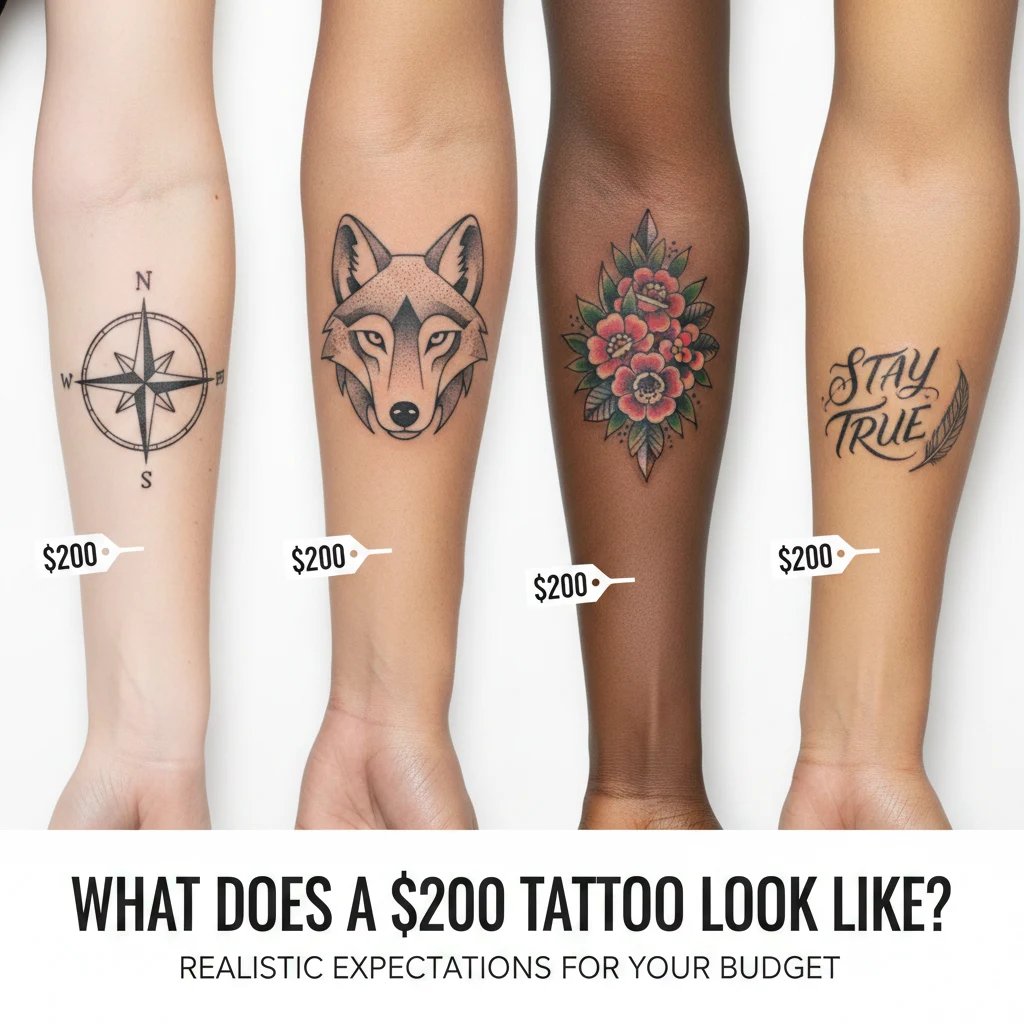
A $200 tattoo typically ranges from 2x2 inches to 4x4 inches, depending on design complexity, artist experience, and studio location. Simple designs with minimal detail can reach the larger end of this range, while intricate work with shading or color will be smaller. Your placement choice, artist's hourly rate, and whether you're getting line work or full shading all influence the final size.
Understanding what $200 gets you helps set realistic expectations and ensures you walk into your consultation prepared. Whether you're a first-timer or adding to your collection, knowing how tattoo pricing works empowers you to make smart design decisions.
This guide breaks down exactly what affects tattoo size at the $200 price point, what you can realistically expect, and how to work with your artist to maximize both quality and coverage within your budget.
Understanding Tattoo Pricing Basics
Tattoo pricing isn't standardized across the industry. Most professional artists charge either an hourly rate or a flat fee based on the design's complexity and size. According to Tattoodo's 2024 industry survey, hourly rates range from $100 to $300 depending on the artist's experience level and geographic location.
At $200, you're typically looking at one to two hours of work with a mid-range artist, or possibly less time with a more experienced professional charging premium rates. Brooklyn studios, for instance, often charge $150-$250 per hour for established artists, meaning your $200 budget covers roughly one hour of tattooing time.
The relationship between time and size isn't linear. A simple 3x3-inch design might take 45 minutes, while a detailed 2x2-inch piece could require two hours. Complexity matters more than raw dimensions when artists calculate pricing.
Shop minimums also affect what you'll get. Many reputable studios set minimums between $80-$150 to cover setup costs, sterilization, and the artist's time. This means even tiny tattoos start at this baseline, making $200 a comfortable budget that moves you beyond minimum-size restrictions.
Factors That Determine Tattoo Size for $200
Design Complexity and Detail Level
Simple line work covers more skin than intricate designs at the same price point. A minimalist outline of a mountain range could span 4 inches, while a detailed portrait might only reach 2 inches square. The difference lies in how long each takes to execute.
Fine line tattoos with delicate details require slower, more precise work. Your artist needs to maintain consistent pressure and spacing, which extends session time. Conversely, bold traditional designs with thick lines and solid color blocks move faster, translating to larger coverage.
Shading adds significant time. A black and grey piece with smooth gradients takes longer than flat color or simple outlines. Realistic shading that creates depth and dimension can double or triple the time needed compared to a flat design of the same size.
Artist Experience and Hourly Rate
Apprentice artists or newer professionals might charge $75-$125 per hour, giving you more size for your $200. However, this trade-off comes with considerations about consistency and experience. Mid-level artists at $150-$200 per hour offer proven skill while keeping your budget reasonable.
Highly sought-after artists charging $250-$400 per hour will produce smaller work for $200, but you're paying for refined technique, artistic vision, and often years of specialization. Their efficiency might mean they complete more in less time, but their rates reflect demand and expertise.
Experience affects speed. A veteran artist might complete a design in 45 minutes that takes a newer artist 90 minutes. This efficiency can actually give you more size with an experienced professional, even at higher hourly rates.
Placement and Body Area
Placement dramatically impacts pricing and size. Flat, easy-to-reach areas like the forearm, shoulder, or calf allow artists to work efficiently. Curved or sensitive areas like ribs, hands, or behind the ear require more time and precision, reducing what $200 covers.
Areas with more nerve endings or thinner skin often need more breaks during the session. This extends total time, even if actual tattooing time remains the same. Some artists charge premium rates for challenging placements like fingers, neck, or face.
Larger, flatter canvases let artists work in longer, continuous strokes. This efficiency means you might get a 4x3-inch piece on your thigh versus a 2x2-inch piece on your wrist, even with identical designs and artists.
Color vs. Black and Grey
Black and grey tattoos typically cover more area for the same price. Single-needle black work or simple grey shading requires fewer passes and less time than color saturation. Your $200 might get you a 3x4-inch black and grey piece versus a 2x3-inch color tattoo.
Color work demands multiple passes to achieve saturation. Artists must build up pigment gradually, especially with lighter colors like yellow or white. Each color also requires cleaning and switching equipment, adding time between sections.
Color blending and gradients add complexity. Creating smooth transitions between hues takes precision and patience. A sunset with multiple color gradients will be smaller than a simple two-tone design at the same price point.
What Size Tattoo Can You Expect for $200?
Small Tattoos (2x2 to 3x3 inches)
At the smaller end, 2x2 to 3x3 inches accommodates detailed work within your budget. This size works perfectly for intricate designs like mandalas, small portraits, or detailed botanical illustrations. You're prioritizing quality and detail over coverage.
These dimensions fit well on wrists, ankles, behind the ear, or as accent pieces on larger body areas. The compact size allows for complete designs that don't feel cut off or incomplete. Think of a detailed rose with shading, a small geometric pattern, or a meaningful symbol with fine details.
For first-time clients, this size range offers a manageable session length, typically 45 minutes to 90 minutes. You'll experience the full tattooing process without committing to a marathon session, making it ideal for testing your pain tolerance and comfort level.
Medium Tattoos (3x3 to 4x4 inches)
The 3x3 to 4x4-inch range represents the sweet spot for $200 budgets with simpler designs. You can get a bold traditional piece, a clean line work design, or a moderately detailed illustration. This size makes a statement without dominating large body areas.
Popular choices in this range include traditional American designs like anchors or swallows, simple script with decorative elements, or nature scenes with moderate detail. The size allows for recognizable imagery that reads clearly from a distance.
Session time typically runs 60 to 90 minutes for this size, depending on complexity. You're getting substantial coverage that feels like a complete tattoo rather than a small accent. Placement options expand significantly, with upper arms, calves, and shoulder blades becoming ideal canvases.
Factors That Might Reduce Size
Highly detailed realism shrinks your coverage area. Photorealistic portraits, intricate mandalas, or complex geometric patterns require meticulous work. A realistic eye with proper shading might only reach 1.5x2 inches for $200, but the impact comes from precision rather than size.
Premium locations like Brooklyn, Los Angeles, or Miami command higher rates. According to Inked Magazine's 2024 pricing analysis, major metropolitan areas charge 20-40% more than smaller cities. Your $200 stretches further in regional markets than coastal urban centers.
Rush jobs or last-minute bookings sometimes carry surcharges. If you need a tattoo completed quickly without advance booking, artists may charge premium rates that reduce what your budget covers. Planning ahead maximizes your investment.
Design Styles and Size Expectations
Minimalist and Fine Line Designs
Minimalist tattoos emphasize clean, simple lines with minimal shading. For $200, you might achieve 3x4 to 4x5 inches of delicate line work. These designs rely on negative space and precise execution rather than heavy detail or shading.
Single-needle or fine line techniques create delicate, subtle tattoos. A simple mountain outline, constellation pattern, or abstract line drawing fits this category. The style's simplicity allows for larger coverage, but requires an artist skilled in consistent, light-handed work.
Fine line work ages differently than bold traditional tattoos. Lines may blur slightly over time, so discuss long-term expectations with your artist. Proper placement on areas with less movement helps preserve detail as the tattoo ages.
Traditional and Bold Designs
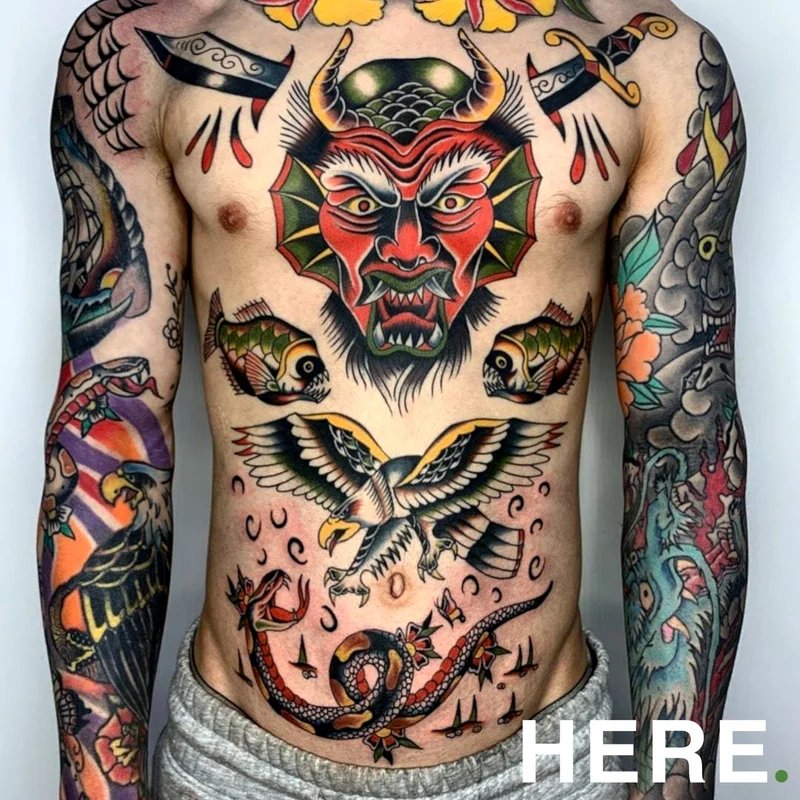
American traditional style features thick outlines and solid color blocks. This approach works efficiently, potentially giving you 4x4 to 5x5 inches for $200. The bold lines and limited color palette mean faster execution and larger coverage.
Traditional designs include classic imagery like roses, daggers, anchors, and swallows. These time-tested designs work at various sizes and age exceptionally well. The bold lines prevent blurring, and solid colors maintain vibrancy longer than subtle gradients.
Neo-traditional adds detail to classic motifs while maintaining bold outlines. You'll get slightly less size than pure traditional work, typically 3x4 to 4x4 inches, but with more dimensional shading and contemporary color palettes.
Realistic and Portrait Work
Realism demands precision and time. Portrait work, photorealistic animals, or detailed landscapes might only reach 2x2 to 2.5x3 inches for $200. The value lies in capturing lifelike detail, proper proportions, and smooth shading that creates dimension.
Black and grey realism focuses on tonal values and smooth gradients. Artists build up layers of shading to create depth, which requires multiple passes and careful blending. A realistic eye, small portrait, or detailed flower falls into this category.
Color realism adds another complexity layer. Matching skin tones, creating realistic lighting, and blending multiple colors extends session time. Expect smaller coverage but stunning visual impact when executed by skilled artists specializing in this style.
Geometric and Mandala Patterns
Geometric tattoos require mathematical precision and symmetry. For $200, expect 2.5x2.5 to 3.5x3.5 inches of detailed geometric work. The style demands perfect lines, consistent spacing, and often intricate patterns that take time to execute properly.
Mandalas combine geometric precision with decorative elements. These circular designs work beautifully at various sizes, but intricate mandalas with multiple layers of detail will be smaller than simpler geometric shapes. The meditative, symmetrical nature makes them popular choices for meaningful tattoos.
Dotwork geometric designs use thousands of individual dots to create shading and patterns. This technique is time-intensive, reducing size but creating unique texture and visual interest. A dotwork mandala might reach 2x2 to 3x3 inches for your budget.
Maximizing Your $200 Tattoo Budget
Choosing the Right Design Complexity
Start with your priorities: size versus detail. If coverage matters most, choose simpler designs with bold lines and minimal shading. If you want intricate detail, accept smaller dimensions and focus on the craftsmanship within that space.
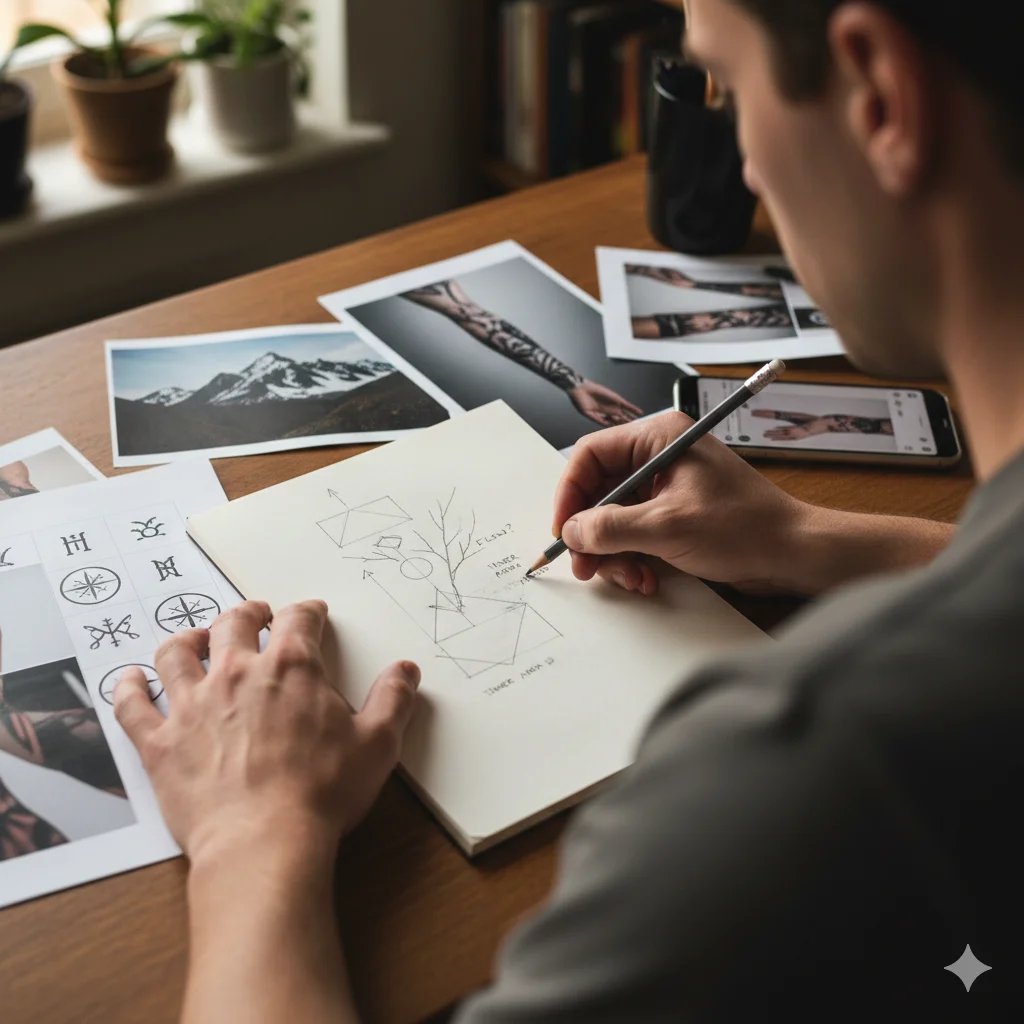
Bring reference images but remain flexible. Your artist can suggest modifications that work better at your size and budget. Simplifying certain elements or adjusting proportions might give you more coverage without sacrificing the design's essence.
Consider designs that work well at smaller scales. Some imagery loses impact when reduced, while other designs remain powerful at compact sizes. Symbols, simple animals, geometric shapes, and botanical elements often translate well to smaller tattoos.
Selecting Optimal Placement
Choose body areas that allow efficient work. Flat surfaces like the outer forearm, upper arm, thigh, or calf let artists work quickly and comfortably. This efficiency translates to more coverage for your budget.
Avoid highly sensitive areas for your first tattoo or when budget-conscious. Ribs, feet, hands, and spine require more breaks and slower work. Save these placements for when you can allocate more budget or break the design into multiple sessions.
Consider how placement affects design orientation. Vertical designs work well on forearms and calves, while horizontal pieces suit shoulders and upper back. Matching your design's natural shape to your chosen placement maximizes visual impact.
Working With Your Artist
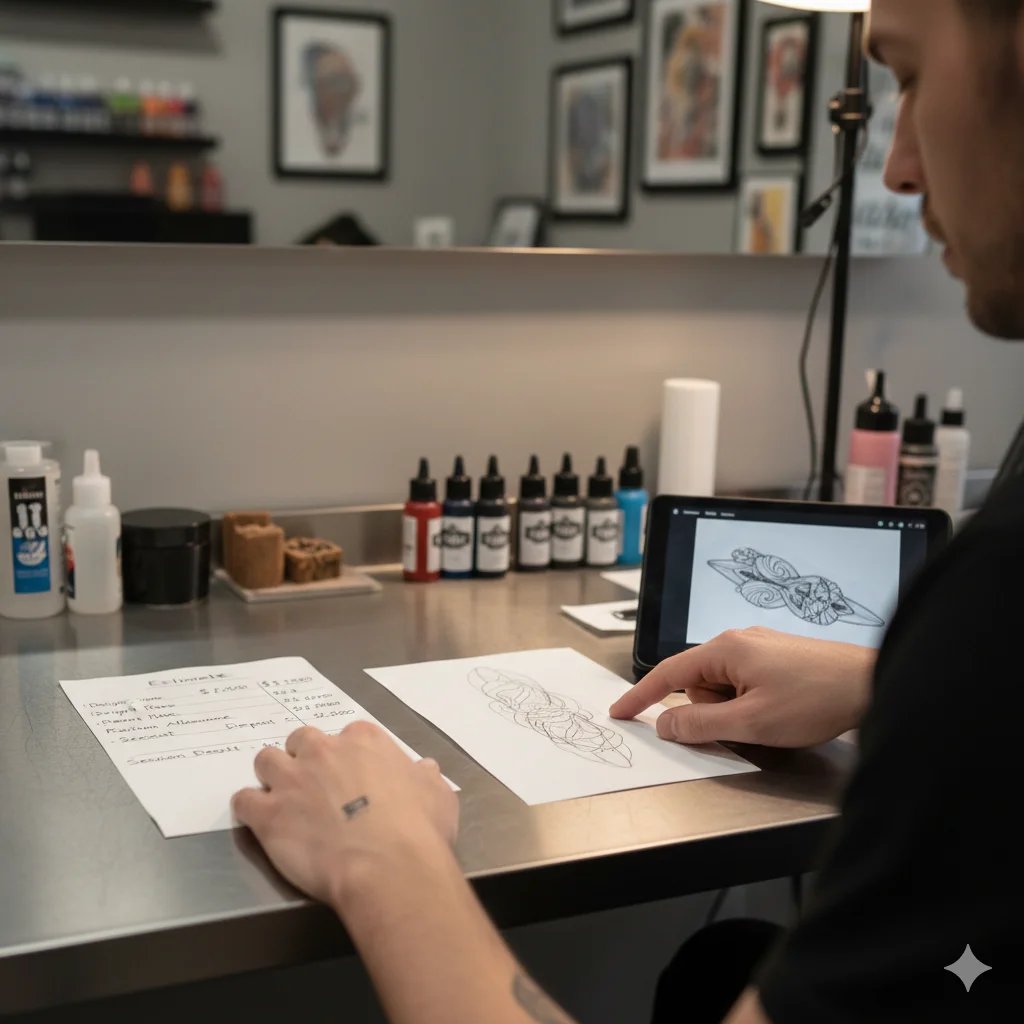
Book consultations before committing. Most artists offer free or low-cost consultations where you discuss your ideas, budget, and expectations. This conversation helps both parties understand what's realistic and prevents disappointment.
Be transparent about your budget from the start. Professional artists appreciate honesty and can design within your constraints. Trying to negotiate after seeing a design creates awkward situations and may compromise the relationship.
Ask about payment structures. Some studios require deposits that apply to your final cost, while others charge separately. Understanding the full financial picture prevents surprises and helps you budget accurately.
Trust your artist's expertise on sizing. If they suggest going slightly smaller for better detail or slightly larger for visual impact, consider their advice seriously. They understand how designs translate to skin and age over time.
Timing and Booking Strategies
Book during slower periods when possible. Some studios offer promotions during traditionally slow months or weekdays. While you shouldn't choose an artist solely based on discounts, timing flexibility might stretch your budget.
Plan ahead rather than booking last-minute. Rush appointments sometimes carry premium pricing, and you'll have limited design revision time. Booking several weeks out gives you time to refine your design and ensures you're getting exactly what you want.
Consider apprentice or newer artists for simpler designs. Many talented artists early in their careers offer lower rates while building portfolios. If your design is straightforward, this option provides quality work at better prices.
Common $200 Tattoo Examples
Text and Script Tattoos
Short phrases or single words work well within $200 budgets. Simple script without elaborate decorative elements might span 4-6 inches depending on font choice and letter height. Clean, readable fonts execute faster than ornate calligraphy.
Adding decorative elements reduces text length. Flowers, vines, or geometric accents around words add visual interest but consume time and budget. A name with a small rose might reach 3-4 inches total, balancing text and imagery.
Font choice significantly impacts pricing. Simple sans-serif or basic script fonts work quickly, while elaborate calligraphy or custom lettering requires more precision. Discuss font options with your artist to find the balance between style and coverage.
Small Animal and Nature Designs
Simple animal outlines or silhouettes maximize size. A clean line drawing of a cat, bird, or wolf might reach 3x4 to 4x5 inches. These designs rely on recognizable shapes rather than detailed features, allowing for larger coverage.
Adding realistic details reduces size but increases impact. A detailed bird with feather texture and shading might only reach 2x3 inches, but the craftsmanship creates a stunning piece. Consider whether you prefer size or detail for your specific design.
Botanical designs like single flowers, leaves, or branches work beautifully at this price point. A rose with moderate shading might span 3x3 inches, while a simple lavender sprig could reach 2x5 inches. The natural, flowing shapes of plants adapt well to various body placements.
Symbols and Icons
Cultural symbols, zodiac signs, or meaningful icons fit comfortably in the $200 range. These designs typically measure 2x2 to 3x3 inches and carry personal significance without requiring large coverage. The compact size works well for discreet placement.
Geometric symbols like triangles, circles, or sacred geometry patterns combine meaning with visual appeal. A simple geometric design might reach 3x3 to 4x4 inches, while complex sacred geometry with intricate internal patterns stays smaller at 2x2 to 3x3 inches.
Combining multiple small symbols creates cohesive designs. Three small icons arranged together might fit within 3x4 inches total, creating a personalized collection of meaningful imagery. This approach works well for representing multiple important concepts or memories.
Simple Portraits and Faces
Tiny portrait work requires specialized skills. A small realistic portrait might only reach 1.5x2 to 2x3 inches for $200, but finding an artist skilled in micro-realism is essential. Not all tattoo artists specialize in small-scale portrait work.
Simplified or stylized portraits allow for larger sizes. An illustrative portrait focusing on key features rather than photorealism might reach 2.5x3 to 3x4 inches. This approach captures likeness while working within budget constraints.
Partial portraits like eyes or lips work well at smaller scales. A detailed eye with proper shading might measure 1.5x2 inches, creating powerful impact in a compact space. These focused designs often carry more emotional weight than full portraits at the same size.
Questions to Ask Your Tattoo Artist
Design and Size Consultation
Start by asking what size they recommend for your specific design. Experienced artists understand how different imagery scales and can suggest optimal dimensions for visual impact and longevity. Their recommendation balances your budget with design integrity.
Request to see similar work in their portfolio at comparable sizes. This gives you realistic expectations for detail level and coverage. If they haven't done similar work at your size and budget, consider whether they're the right artist for this specific piece.
Discuss how the design will age over time. Some details blur or fade as tattoos age, especially in smaller sizes. Understanding long-term expectations helps you make informed decisions about detail level and placement.
Ask about their hourly rate and estimated session time. Getting specific numbers prevents surprises and helps you understand exactly what $200 covers. Some artists provide time estimates, while others prefer to work until the piece is complete within your budget.
Pricing and Payment
Clarify what's included in the quoted price. Does it cover touch-ups, or are those separate? Understanding the full cost structure prevents unexpected expenses down the line. Most reputable artists include one free touch-up session within the first few months.
Ask about deposit requirements and refund policies. Deposits typically range from $50-$100 and secure your appointment. Understanding cancellation policies protects both you and the artist if circumstances change.
Inquire about payment methods accepted. Most studios take cash, credit cards, or digital payments, but some prefer specific methods. Knowing this beforehand ensures a smooth transaction on tattoo day.
Discuss tipping expectations. While not mandatory, tipping 15-20% is standard for good service. Factor this into your total budget to avoid awkwardness after your session.
Aftercare and Touch-Ups
Ask for detailed aftercare instructions specific to your tattoo. Different styles and placements may require slightly different care approaches. Proper aftercare ensures your tattoo heals well and maintains its appearance.
Understand the touch-up policy. Most artists offer free touch-ups within 3-6 months if you've followed aftercare instructions. Clarify what's covered and what might incur additional charges.
Request product recommendations for healing. Your artist can suggest specific ointments, lotions, or cleaning products that work well with their technique and ink choices. Following their recommendations optimizes healing.
Ask about long-term maintenance. Some placements or styles require more frequent touch-ups than others. Understanding maintenance expectations helps you plan for the tattoo's lifetime care.
Preparing for Your $200 Tattoo Session
Before Your Appointment
Eat a substantial meal 1-2 hours before your session. Low blood sugar can increase pain sensitivity and cause lightheadedness. Choose protein-rich foods that provide sustained energy throughout your appointment.
Stay hydrated in the days leading up to your tattoo. Well-hydrated skin takes ink better and heals more efficiently. Avoid alcohol for at least 24 hours before your appointment, as it thins blood and can cause excessive bleeding.
Get adequate sleep the night before. Fatigue lowers pain tolerance and makes sitting through your session more challenging. Aim for 7-8 hours of quality sleep to ensure you're physically and mentally prepared.
Wear appropriate clothing that provides easy access to your tattoo placement. Loose, comfortable clothes you don't mind getting ink on work best. Consider bringing a change of clothes if your placement might stain what you're wearing.
During the Session
Communicate openly with your artist about pain levels. If you need breaks, speak up. Professional artists expect clients to need occasional pauses, especially for sensitive areas or longer sessions.
Bring distractions like headphones, podcasts, or music. Many clients find that focusing on something other than the tattooing process helps manage discomfort. Ask your artist if they're comfortable with you using headphones during the session.
Stay still and avoid sudden movements. Unexpected motion can cause mistakes or injuries. If you need to move, cough, or sneeze, warn your artist first so they can lift the needle safely.
Avoid bringing large groups of friends. While one support person is usually fine, crowds distract the artist and create cramped working conditions. Respect the studio environment and your artist's need to concentrate.
After Your Session
Follow aftercare instructions precisely. Your artist's guidance is based on their experience with how their specific technique and inks heal. Deviating from instructions can compromise healing and final appearance.
Avoid swimming, hot tubs, and excessive sun exposure during healing. Submerging fresh tattoos introduces infection risks, while sun exposure can fade ink and damage healing skin. Plan your tattoo timing around these restrictions.
Don't pick at scabs or scratch healing tattoos. This removes ink and can cause scarring or uneven healing. If itching becomes intense, gently pat the area or apply recommended moisturizer rather than scratching.
Schedule your touch-up appointment before leaving the studio. Booking while you're there ensures you secure a spot within the optimal touch-up window and demonstrates your commitment to maintaining the tattoo's quality.
Conclusion
A $200 budget typically gets you a tattoo between 2x2 and 4x4 inches, with the exact size depending on design complexity, artist experience, and your chosen placement. Simple, bold designs maximize coverage, while intricate, detailed work prioritizes craftsmanship over size. Understanding these trade-offs helps you make informed decisions that align with your vision and budget.
The key to satisfaction lies in clear communication with your artist and realistic expectations. Your $200 investment can produce a beautiful, meaningful tattoo when you choose appropriate designs, trust your artist's expertise, and prioritize quality over sheer size. Whether you're getting your first tattoo or adding to your collection, focusing on the design's personal significance and execution quality ensures you'll love the result.
At Here Tattoo in Brooklyn, we specialize in helping clients maximize their tattoo budgets through thoughtful design consultation and expert execution. Our experienced artists work with you to create custom pieces that balance your vision, budget, and desired size, ensuring every tattoo we create is something you'll treasure for life. Ready to turn your idea into a stunning tattoo? Book your consultation today and let's design something extraordinary together.
Frequently Asked Questions
Can I get a full sleeve tattoo for $200?
No, a full sleeve tattoo typically costs $1,500-$5,000 depending on detail and artist rates. For $200, you might get a small piece that could eventually become part of a sleeve, but completing a full sleeve requires multiple sessions and significantly more investment.
How long does a $200 tattoo session usually take?
Most $200 tattoo sessions last 1-2 hours depending on the artist's hourly rate and design complexity. Artists charging $150 per hour will work longer than those charging $250 per hour, but both should complete a quality piece within your budget.
Will a $200 tattoo look cheap or low quality?
Not necessarily. Quality depends on artist skill, not just price. A $200 tattoo from an experienced professional can look stunning, especially if you choose appropriate designs for that budget. Focus on finding skilled artists rather than assuming higher prices automatically mean better quality.
Can I negotiate tattoo prices to get a bigger design?
Most professional artists don't negotiate on established rates, as this undervalues their expertise and time. Instead, discuss design modifications that work within your budget, such as simplifying details or adjusting size. Respecting artist pricing builds better working relationships.
Should I tip my tattoo artist if I'm already paying $200?
Yes, tipping 15-20% is standard practice for good service, similar to restaurant tipping. If your artist does excellent work and provides a positive experience, plan to tip $30-$40 on top of your $200 tattoo cost.
How much does tattoo placement affect the final size?
Placement significantly impacts size because some body areas require more time and precision. Easy-to-reach, flat areas like forearms might give you 20-30% more coverage than difficult spots like ribs or hands at the same price point.
Can I split a larger design into multiple $200 sessions?
Absolutely. Many clients build larger pieces over multiple sessions, paying $200 each time. This approach makes bigger tattoos more affordable and gives you breaks between sessions. Discuss this strategy with your artist during consultation to plan a cohesive multi-session design.