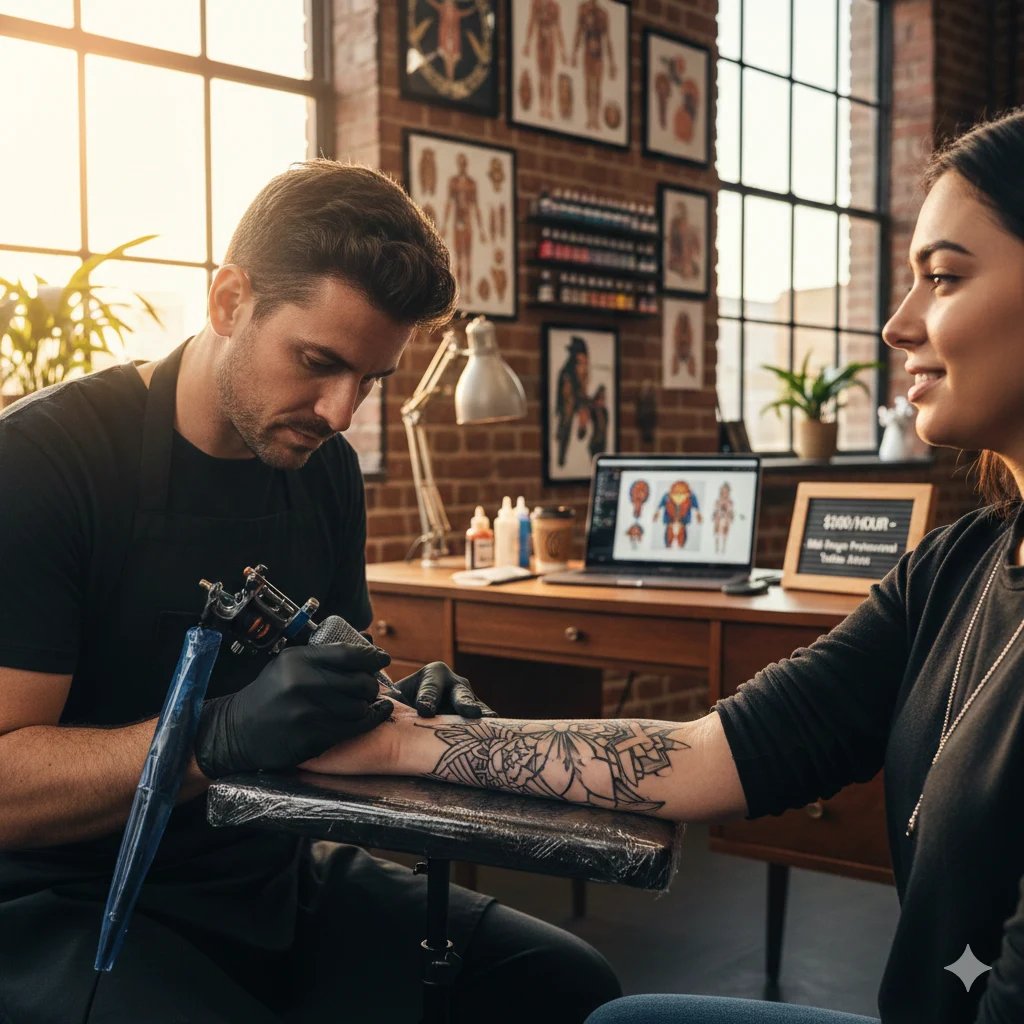
Yes, $100 per hour is a solid mid-range rate for an experienced tattoo artist, especially in major cities like Brooklyn. This pricing typically reflects an artist with 3-5 years of professional experience, a strong portfolio, and proficiency in multiple styles. However, whether it's "good" depends on the artist's skill level, your design complexity, and local market rates.
Understanding tattoo pricing helps you make confident decisions about your investment. Hourly rates vary dramatically based on experience, location, specialization, and demand—ranging from $80 for newer artists to $300+ for internationally recognized names.
This guide breaks down what $100/hour gets you, how to evaluate artist pricing, quality indicators to look for, and smart questions to ask before booking your session.
What Does $100 Per Hour Actually Get You?
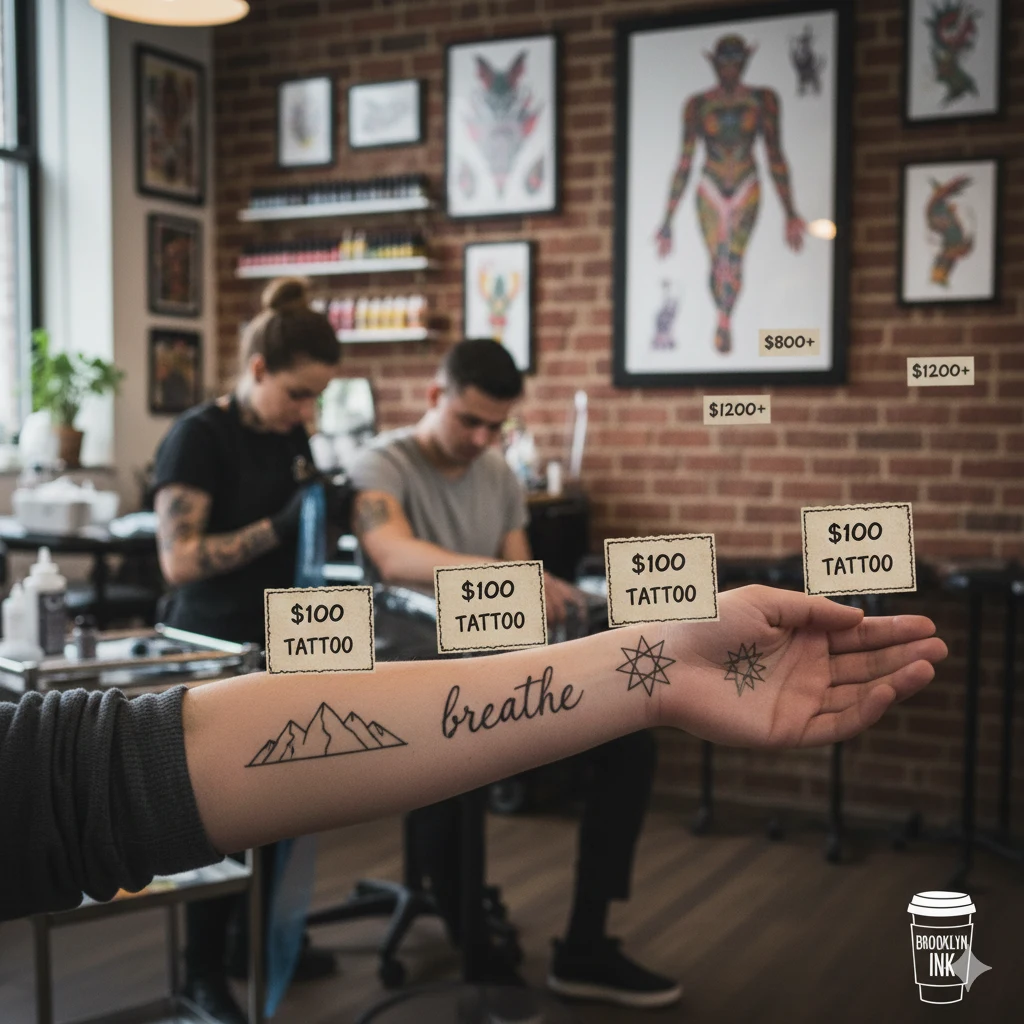
At the $100/hour price point, you're typically working with a mid-level professional artist who has moved beyond apprenticeship but hasn't yet reached master-level status. This rate usually indicates someone with a solid foundation in technical skills, consistent line work, and the ability to execute clean, well-saturated tattoos that heal properly.
Artists charging this rate generally maintain professional studios with proper sterilization protocols, use quality inks and equipment, and carry liability insurance. You should expect a consultation process where they discuss your design, offer artistic input, and create custom artwork rather than simply pulling flash designs off the wall.
The $100/hour artist typically has 3-7 years of active tattooing experience and a portfolio demonstrating competency across multiple styles. They understand skin behavior, proper depth control, and how designs age over time. Their work should show consistent quality rather than occasional great pieces mixed with questionable ones.
This pricing tier often includes artists who are building their reputation and client base. They're skilled enough to execute most designs well but may not have the speed, efficiency, or specialized expertise of higher-priced artists. A piece that takes them four hours might take a $200/hour artist only two hours, potentially making the total cost comparable.
How Tattoo Artist Rates Are Determined
Experience and skill level form the foundation of tattoo pricing. Artists typically start around $80-100/hour after completing apprenticeships, gradually increasing rates as their technical abilities improve and demand grows. Each rate increase reflects measurable improvements in speed, consistency, and artistic capability.
Geographic location dramatically impacts pricing structures. Brooklyn artists command higher rates than those in smaller markets due to elevated overhead costs—studio rent, licensing fees, and general cost of living. A $100/hour rate in Brooklyn positions an artist in the mid-range, while the same rate might represent premium pricing in smaller cities.
Specialization adds significant value to an artist's hourly rate. Those who master technically demanding styles like realism, geometric patterns, or Japanese traditional work often charge premium rates because these specialties require years of focused practice beyond general tattooing skills. An artist exceptional at photorealistic portraits might charge $150-250/hour while maintaining $100/hour for simpler work.
Artist demand and booking timelines directly influence pricing. When an artist consistently books 2-3 months out, raising rates helps manage demand while reflecting their market value. Artists with immediate availability at $100/hour might indicate they're still building clientele or working in a less competitive market.
Studio overhead costs factor into rate calculations. Established shops in prime locations pass along higher operational costs through artist rates. Private studios with lower overhead might offer comparable quality at reduced rates, though this requires careful vetting of health and safety standards.
Quality Indicators Beyond Hourly Rate
Portfolio consistency reveals more about artist quality than any single impressive piece. Examine 20-30 recent works rather than their best 5-6 pieces. Look for consistent line weight, smooth color saturation, proper contrast, and clean healing in healed tattoo photos. Inconsistent quality suggests unreliable results.
Technical fundamentals demonstrate professional competency. Clean, confident lines without blowouts or shakiness indicate proper machine control and hand stability. Smooth color gradients without patchiness show understanding of skin saturation. Proper black saturation in contrast areas ensures the tattoo remains readable as it ages.
Healed work photography separates skilled artists from those who only show fresh tattoos. Artists confident in their work showcase pieces after 6-12 months of healing, demonstrating how their technique holds up over time. Fresh tattoos can hide technical flaws that become obvious after healing.
Client communication and consultation quality reflect professionalism. Artists who ask detailed questions about placement, lifestyle, and design preferences show investment in creating appropriate work. Those who rush consultations or dismiss your input may prioritize volume over quality outcomes.
Studio environment and hygiene practices indicate professional standards. Proper autoclave sterilization, single-use needles, barrier film on surfaces, and clean workspaces are non-negotiable. Artists cutting corners on safety often cut corners on quality too.
Comparing $100/Hour to Other Price Points
Budget tier artists ($80-90/hour) typically include newer professionals building portfolios or artists in lower-cost markets. This range can offer excellent value when working with talented newer artists, but requires careful portfolio review since experience levels vary significantly. Some produce quality work while developing speed and efficiency.
The $100-150/hour mid-range represents experienced professionals with proven track records. This bracket offers the best value for most custom work—artists have refined their techniques, work efficiently, and produce consistently good results without premium pricing. Most clients find their ideal artist match in this range.
Premium artists ($150-250/hour) bring specialized expertise, exceptional portfolios, and often years-long waiting lists. This tier includes artists known for specific styles, those with celebrity clientele, or masters with 15+ years of experience. The higher rate reflects both skill and demand, not just ego.
Elite-level artists ($250-500+/hour) represent the top 1% of the industry—award winners, international guest artists, and recognized innovators in their specialties. At this level, you're paying for a name, guaranteed exceptional results, and often a years-long waitlist. Few pieces justify this investment unless you're seeking the absolute best in a specific style.
Shop minimums complicate hourly rate comparisons. A $100/hour artist with a $150 minimum charges more for small pieces than a $120/hour artist with no minimum. Always ask about minimums when comparing pricing for smaller designs.
What Affects Your Total Cost Beyond Hourly Rate
Design complexity dramatically impacts session length and total cost. A simple line-work design might take two hours, while a detailed realistic portrait of the same size could require 6-8 hours. Artists charging the same hourly rate produce vastly different total costs based on design demands.
Placement location affects both difficulty and time requirements. Ribs, hands, feet, and other sensitive or technically challenging areas take longer to tattoo due to client pain tolerance and skin texture variations. What takes three hours on your arm might require five hours on your ribs with breaks.
Size and detail density multiply time requirements exponentially, not linearly. Doubling a tattoo's dimensions often quadruples the time needed because surface area increases geometrically. Adding intricate details to larger pieces can push sessions from 4 hours to 8+ hours.
Color work versus black-and-gray impacts session length. Color tattoos require multiple passes for proper saturation, careful blending, and often more total time than comparable black-and-gray pieces. Some artists charge different rates for color work due to increased material costs and time investment.
Your pain tolerance and sitting ability directly affect session efficiency. Clients who need frequent breaks or can only sit for 2-3 hours turn a potential single-session piece into multiple appointments, adding setup time and potentially increasing total costs if the artist charges per session rather than purely hourly.
Touch-up policies vary by artist and affect long-term value. Some include one free touch-up session within 6-12 months, while others charge for all touch-up work. Artists confident in their work typically offer complimentary touch-ups for any technical issues, though client-caused problems (sun damage, poor aftercare) may incur charges.
Red Flags in Tattoo Pricing
Unusually low rates for claimed experience levels often indicate quality issues or corner-cutting on safety. An artist claiming 10 years of experience but charging $60/hour raises questions about why their rates haven't increased with skill development. Legitimate reasons exist (new location, building clientele), but investigate thoroughly.
Inconsistent pricing without clear explanation suggests unprofessional business practices. Artists should have transparent rate structures based on piece size, complexity, or time estimates. Those who quote wildly different prices for similar work may be price-gauging or lack business organization.
Pressure tactics or rush bookings indicate problematic business practices. Professional artists respect your decision-making timeline and never pressure immediate deposits. Those pushing for same-day bookings or immediate commitments often struggle with client retention for good reasons.
Unwillingness to show healed work or provide references suggests the artist lacks confidence in long-term results. Every experienced artist should have healed photos and satisfied clients willing to share experiences. Resistance to these requests is a major warning sign.
No consultation process or dismissal of your design input indicates an artist more interested in executing their vision than creating your ideal tattoo. Collaborative artists invest time understanding your goals, offering professional guidance while respecting your preferences.
Unclear policies on deposits, cancellations, or touch-ups create potential conflicts. Professional artists provide written policies covering deposits (typically $50-200 or 20% of estimated cost), cancellation terms, and touch-up procedures. Verbal-only agreements often lead to disputes.
Questions to Ask Before Booking
"Can I see healed photos of similar work?" This question reveals whether the artist's technique produces lasting results. Fresh tattoos can mask technical issues that appear during healing. Artists should readily share healed work from 6-12 months post-tattoo.
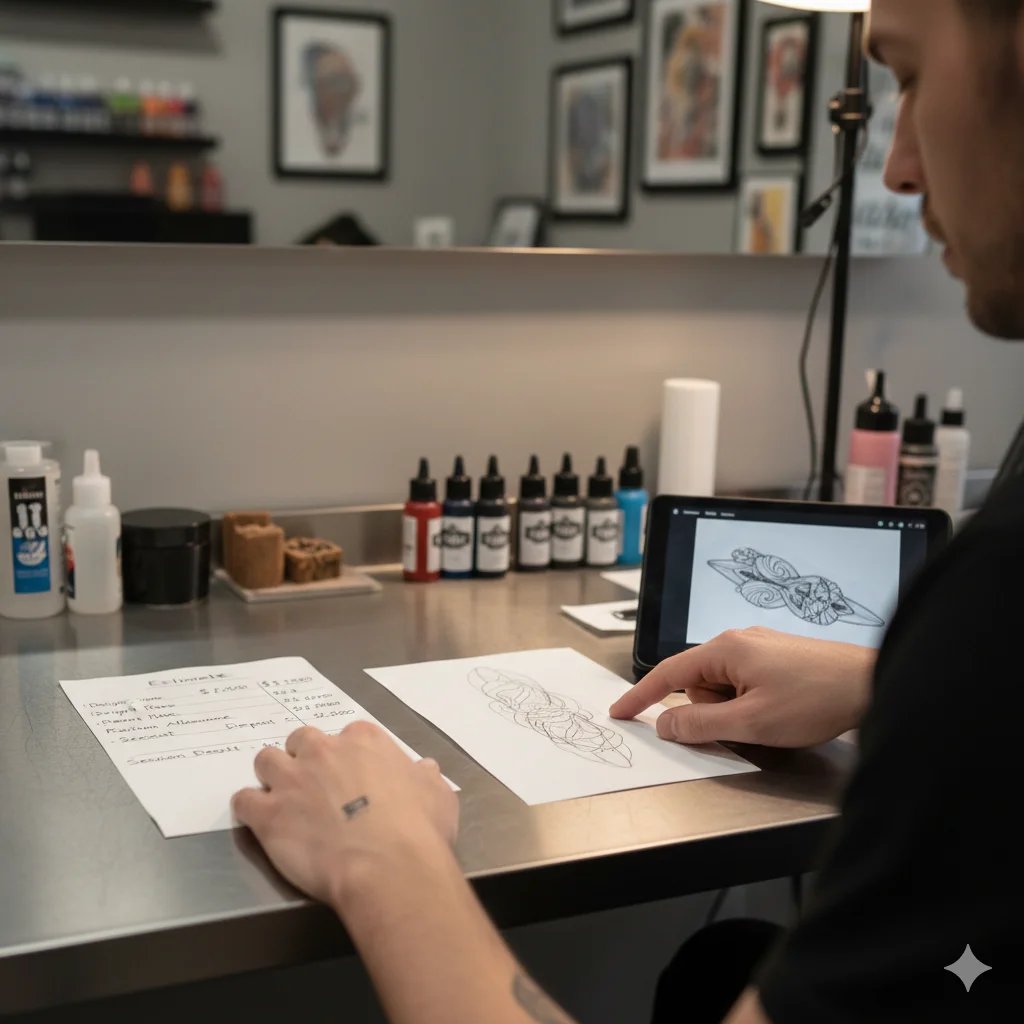
"What's your estimated timeline for this design?" helps gauge both the artist's efficiency and your total investment. Experienced artists provide reasonably accurate time estimates based on design complexity, size, and placement. Vague answers suggest inexperience or poor planning.
"What's included in your hourly rate?" clarifies whether consultations, design time, or touch-ups cost extra. Some artists include design development in their rate, while others charge separately. Understanding the complete cost structure prevents surprise charges.
"How do you handle touch-ups?" establishes expectations for any needed corrections. Professional artists typically offer one complimentary touch-up for technical issues within 6-12 months, though policies vary. Clarify what constitutes a technical issue versus client-caused damage.
"What's your deposit policy and cancellation terms?" protects both parties. Standard deposits range from $50-200 or 20% of estimated cost, typically non-refundable but applied to your final cost. Understand rescheduling policies and notice requirements.
"Can you walk me through your sterilization process?" demonstrates your attention to safety and the artist's professionalism. Competent artists gladly explain their autoclave procedures, single-use equipment, and barrier protocols. Defensiveness about safety questions is a red flag.
Making the Value Assessment
Calculate cost per quality year rather than just upfront price. A $400 tattoo from a skilled artist that looks great for 20+ years costs $20 per year. A $200 tattoo requiring cover-up work in 5 years ultimately costs more in money, time, and skin real estate.
Consider the artist's efficiency alongside their hourly rate. A $150/hour artist who works quickly might complete your piece in three hours ($450 total) while a $100/hour artist takes six hours ($600 total). Total cost and time investment matter more than hourly rate alone.
Evaluate portfolio alignment with your design goals. An artist charging $120/hour who specializes in your desired style delivers better value than a $100/hour generalist. Specialization often means better results, fewer revisions, and higher satisfaction despite slightly higher rates.
Factor in long-term satisfaction and pride in your tattoo. You'll wear this artwork for decades. The difference between a good tattoo and a great one far outweighs the $100-300 price difference when amortized over a lifetime of wear.
Research local market rates for comparable quality. Brooklyn's tattoo market supports higher rates than many regions due to concentration of skilled artists and higher operating costs. A $100/hour Brooklyn artist might be equivalent to a $75/hour artist in a smaller market.
Trust your consultation experience. An artist who listens carefully, offers thoughtful design input, and makes you feel comfortable often delivers better results than a technically skilled artist with poor communication. The collaborative relationship significantly impacts your final piece's success.
Conclusion
$100 per hour represents fair mid-range pricing for experienced tattoo artists, particularly in major markets like Brooklyn. This rate typically indicates solid technical skills, professional standards, and the ability to execute quality custom work that ages well. However, the "goodness" of this rate depends entirely on the specific artist's portfolio quality, specialization, efficiency, and how well their style aligns with your design goals.
Smart tattoo clients evaluate total value rather than just hourly rates. Consider the artist's portfolio consistency, healed work quality, specialization in your desired style, and estimated total project cost. A slightly higher hourly rate often delivers better long-term value through superior results, efficient work, and fewer future regrets.
At Here Tattoo in Brooklyn, we believe in transparent pricing that reflects our artists' experience and specialization. We'll walk you through our rate structure, show you extensive healed work, and provide detailed project estimates during your consultation. Your tattoo is a lifetime investment—let's ensure you get exceptional value and a piece you'll love for decades. Contact us to discuss your design and get a personalized quote.
Frequently Asked Questions
How much should I tip on a $100/hour tattoo?
Standard tipping ranges from 15-20% of the total cost, similar to other service industries. For a $400 tattoo (4 hours at $100/hour), a $60-80 tip is appropriate. Tip based on the artist's professionalism, quality of work, and your overall experience. Exceptional work or artists who go above expectations warrant tips at the higher end.
Do more expensive tattoo artists work faster?
Generally yes—experienced artists charging premium rates often work more efficiently due to refined techniques and muscle memory developed over thousands of hours. A $200/hour artist might complete in 3 hours what a $100/hour artist needs 5 hours for, potentially making total costs comparable. However, rushing quality work is never advisable regardless of rate.
Should I negotiate tattoo prices with artists?
Professional tattoo artists set rates based on experience, overhead costs, and market value—negotiating is generally inappropriate and often offensive. If pricing exceeds your budget, discuss design modifications to reduce complexity or size rather than asking for discounts. Some artists offer payment plans for larger pieces, which is acceptable to inquire about.
Is it worth paying more for a specialized artist?
Absolutely, when the specialization matches your design needs. An artist who focuses exclusively on Japanese traditional work will execute that style far better than a generalist, even if they charge 30-50% more. Specialization represents years of focused practice and typically delivers superior results in that specific style, making the premium worthwhile for significant pieces.
How do I know if an artist is overcharging?
Research local market rates for artists with comparable experience and portfolio quality. Check multiple artists' pricing in your area, examine their portfolios side-by-side, and read client reviews. Overcharging becomes apparent when rates significantly exceed local norms without corresponding quality, experience, or specialization to justify the premium.
Can I get a quality tattoo for less than $100/hour?
Yes, particularly from talented newer artists building their portfolios or artists in lower-cost markets. Carefully review portfolios focusing on healed work, technical consistency, and style alignment with your design. Some excellent artists charge less due to location, lower overhead, or intentionally accessible pricing rather than skill limitations.
What's the difference between hourly rates and flat-rate pricing?
Hourly rates charge for actual time spent tattooing, beneficial for complex pieces with uncertain timelines. Flat rates provide cost certainty upfront, common for flash designs or pieces the artist can accurately time-estimate. Neither is inherently better—hourly rates offer flexibility for custom work, while flat rates eliminate cost uncertainty for straightforward designs.